Implant Site Development Techniques: A Comprehensive Narrative Review of Hard and Soft-Tissue Augmentation Approaches
Kaviya P T
*

Department of Prosthodontics, Government Dental College, Kottayam, Kerala, India.
Sandhya M Raghavan
Department of Prosthodontics, Government Dental College, Kottayam, Kerala, India.
Adhershitha A R
Department of Prosthodontics, Government Dental College, Kottayam, Kerala, India.
Rajesh C
Department of Prosthodontics, Government Dental College, Kottayam, Kerala, India.
Indu Raj
Department of Prosthodontics, Government Dental College, Kottayam, Kerala, India.
Shreya Manoj
Department of Prosthodontics, Government Dental College, Kottayam, Kerala, India.
*Author to whom correspondence should be addressed.
Abstract
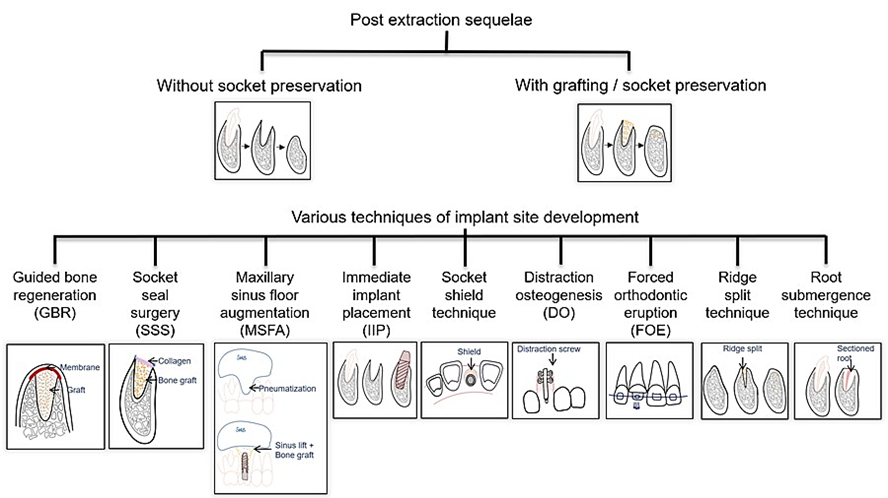
The significance of replacing missing teeth is undeniable. Increasingly, patients are opting for implant-supported prostheses. Nevertheless, several challenges arise during the implant placement process. The most crucial criterion for implant placement is the availability of adequate bone at the edentulous site. Since numerous patients lack ideal bone dimensions, such as height and width, it is necessary to implement certain measures to preserve or promote bone formation in that region. It has been proven that Alveolar Ridge Preservation (ARP) or Implant Site Development (ISD) is superior to unassisted socket healing, and it minimizes post-extraction alveolar bone loss and soft-tissue loss. There are various techniques of ISD, such as bone grafting alone or in combination with Guided Bone Regeneration (GBR), Socket Seal Surgery (SSS), Maxillary Sinus Floor Augmentation (MSFA), Immediate Implant Placement (IIP), socket shield technique, Distraction Osteogenesis (DO), Forced Orthodontic Eruption (FOE), the ridge split technique, and the root submergence technique. A literature search was conducted across PubMed, Google Scholar, Scopus, and Cochrane using keywords such as “implant site development,” “ridge augmentation,” “alveolar ridge preservation,” and “sinus lift,” on studies published between 1982 and 2025. Nevertheless, given the lack of sufficient evidence to determine the superiority of different approaches, knowledge of this topic is crucial in making an informed choice of methods in specific clinical situations. The technique selection should therefore be based on defect morphology, anatomical constraints, and clinical expertise. This review article highlights a comprehensive range of implant site development techniques from various dental specialties. Current trends include minimally invasive approaches, digitally driven techniques, and bio-printed materials. Limitations include a lack of high-quality long-term randomised control trials following CONSORT guidelines with adequate sample sizes and consistent results, making direct comparison among different techniques difficult.
Graphical Abstract
Keywords: Alveolar bone grafting, alveolar ridge augmentation, bone resorption, dental implant therapy, forced eruption, socket-shield technique